Je bent je ingevulde velden bij deze pagina aan het verwijderen. Ben je zeker dat je dit wilt doen?
You are erasing your filled-in fields on this page. Are you sure that is what you want?
Nieuwe Versie BeschikbaarNew Version Available
Er is een update van deze pagina. Als je update naar de meest recente versie, verlies je mogelijk je huidige antwoorden voor deze pagina. Hoe wil je verdergaan ?
There is an updated version of this page. If you update to the most recent version, then your current progress on this page will be erased. Regardless, your record of completion will remain. How would you like to proceed?
This section describes the geometry and useful symmetry of odd functions, as well as how to test for them analytically.
There are certain properties that turn out to be really helpful and exploitable - especially in physics and calculus courses. We
discuss one of these here, the so-called “odd” functions.
Lecture Video
_
Text and details
There are two main ways to try and understand the “odd property”, and it comes down to the fact that it is essentially a
type of symmetry. We begin with the geometric view - explicitly discussing the symmetry, and then continue on
to the analytic view to nail down the corresponding algebraic property, which will ultimately give us the formal
definition.
Geometric Perspective
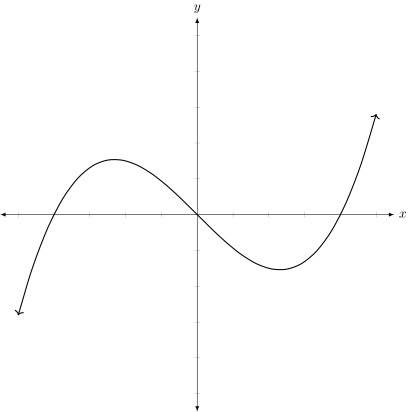
Axial symmetry is usually what people think of when they think about symmetry - something that can be folded and lined up. But
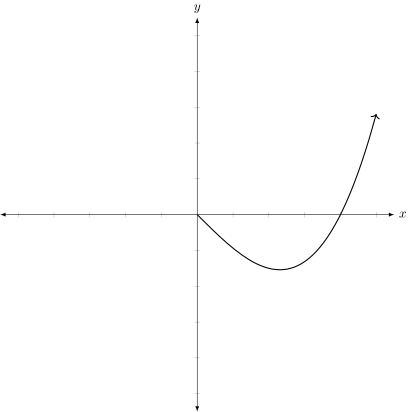
that isn’t the only type of symmetry. Consider the following graph and see if you can pin down the pattern that we might call a
type of symmetry for this one.
If you aren’t sure, let’s see if this helps:
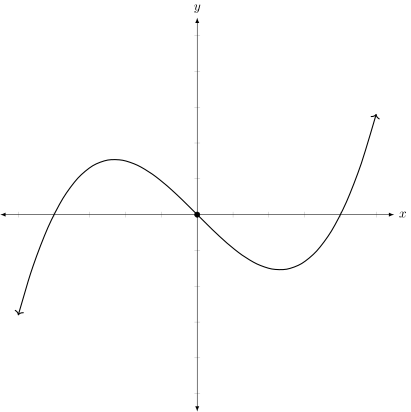
Imagine putting a pin through the origin, and then slowly spinning the graph. Obviously after a full rotation it will line up with
the original, like any image. But what makes this an interesting picture is that this happens even earlier. Indeed, after only 180
degrees we will end up with the same picture that we started with.
This kind of symmetry is called rotational symmetry. Technically rotational symmetry is when there is any amount of rotation
that realigns your picture, but the “odd property” corresponds specifically to a 180 degree rotation. Thus moving this picture
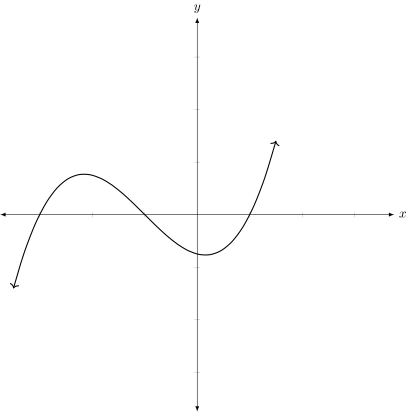
slightly left or right for example, would result in a graph that is no longer rotationally symmetric. For example, if we start with the
following graph:
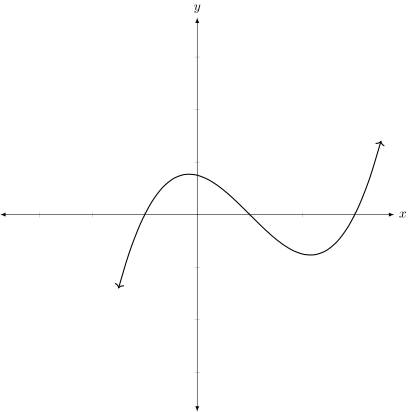
Spinning it 180 degrees gets us:
Although similar, it isn’t the same image - thus it doesn’t have the “odd property”. Indeed, with some consideration we can
likely see that any graph that doesn’t pass through the origin can’t possibly have the “odd property”.
Analytic Perspective
Let’s return to our original graph, but this time we will start with the segment to the right of the -axis.
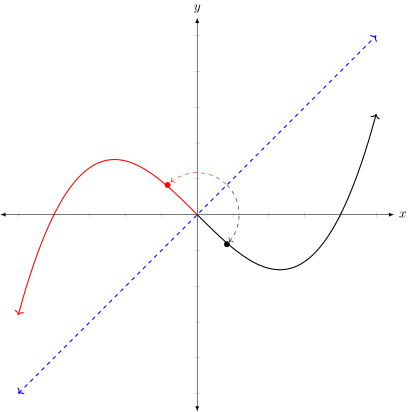
We are missing the left side of the graph, but we can reproduce it using our knowledge of the original symmetry of the graph.
Indeed can trace out the missing segment of graph by remembering that whenever the value goes up on the right side, we want it
to go down on the left side. This gets us:
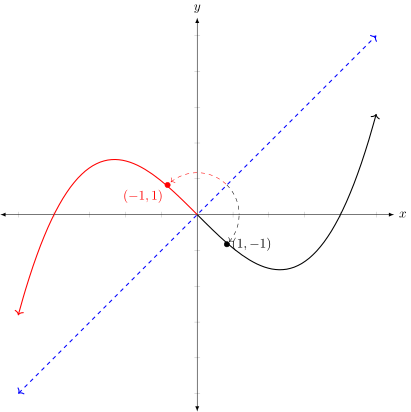
So, if we go the same distance in the opposite direction - the -value has the same size, but also in the opposite direction. It
might be easier if we label some points to see what we mean:
As we can see, the rotational symmetry means that both signs flip - if we go the opposite direction for , the value also goes the
opposite direction. For reasons beyond the scope of this course, functions with this kind of symmetry are called “odd”
functions.
Odd Function Let be a function. We say that is an odd function if, for any , , or equivalently .
This kind of rotational symmetry can be difficult to picture, but it turns out to be very helpful because we know that the negative
sign essentially “passes through” the function - which will have drastic (and incredibly useful) effects in calculus and
physics.
 Precalculus Algebra