Je bent je ingevulde velden bij deze pagina aan het verwijderen. Ben je zeker dat je dit wilt doen?
You are erasing your filled-in fields on this page. Are you sure that is what you want?
Nieuwe Versie BeschikbaarNew Version Available
Er is een update van deze pagina. Als je update naar de meest recente versie, verlies je mogelijk je huidige antwoorden voor deze pagina. Hoe wil je verdergaan ?
There is an updated version of this page. If you update to the most recent version, then your current progress on this page will be erased. Regardless, your record of completion will remain. How would you like to proceed?
This section aims to name and explain the common sets of numbers.
Throughout this course, and all future math courses, we will be referring to various numbers by their type - almost exclusively.
To ensure that everyone is on the same page we cover the names and properties of these numbers here. Keep in mind that future
segments will use the vocabulary we are covering here constantly and thus knowing the differences between the various types of
numbers will be absolutely necessary.
Lecture Video
_
Text and details
In this course there are six different types of numbers that we will be using.
Natural Numbers:
Natural numbers are whole numbers (no necessary fractions or decimal point) that are strictly
positive - i.e. 1, 2, 3, 4, ...
Integers:
Integers are whole numbers (no necessary fractions or decimal point) that are positive, negative, and zero - i.e.
..., -3, -2, -1, 0, 1, 2, 3, ...
Rational Numbers:
Rational numbers are any numbers that can be represented by a fraction, where the numerator and
denominator are both integers. This includes any decimal that has a finite or repeating pattern of decimal digits.
Thus a rational number has the form where and are both integers. If a number has a finite number of digits to
the right of the decimal point then it can be represented this way by putting the number without a decimal digit in
the numerator, and then ten to the power of the original number of decimal digits.
By way of example, if you have the number it has decimal digits to the right of the decimal point, so you can
represent it by the fraction .
For repeating decimals, it is easier to demonstrate with an example. Consider the number . You would start by
representing the number with a variable, e.g. , and then multiply both sides by to the number of repeating digits -
in this case 2 - so we would multiply both sides by or . This gives us: Then we can subtract from both
sides, remembering that is really . This gets us: Notice that the cancel on the right hand side, bringing us
down to a finite number of digits on the right, which means we can solve for and get a fraction. i.e.
The last step we needed to multiply the top and bottom of the fraction by to clear the decimal digit, which gives us a
fraction representation (where both numbers are integers) for our original infinite repeating decimal number - thus is a
rational number. Notice that we could simplify the fraction, but we don’t need to in order to prove that is a rational
number.
Real Numbers:
Real numbers are basically any number that you normally deal with. This includes all the numbers we’ve talked
about prior, as well as things like square roots that aren’t rational, like . The important part here is the distinction between
real numbers and complex numbers, which we will cover in a moment.
Irrational Numbers:
Irrational numbers are defined by what they aren’t - meaning that irrational numbers are any real
numbers that aren’t rational. Thus these are numbers that have infinitely many decimal digits, but no repeating pattern.
This includes weird numbers like , but also more seemingly innoculous numbers, like . As a general rule, roots of values that
don’t end up being a nice value (like tend to be irrational.
Complex Numbers:
Complex numbers are numbers that include some multiple and/or power of the imaginary constant , where .
We will have a full segment covering complex numbers and how they work during the semester, so although we mention them
here you need not know them for a while (and if you’ve never heard of them, no worries! We will discuss them in detail
later!)
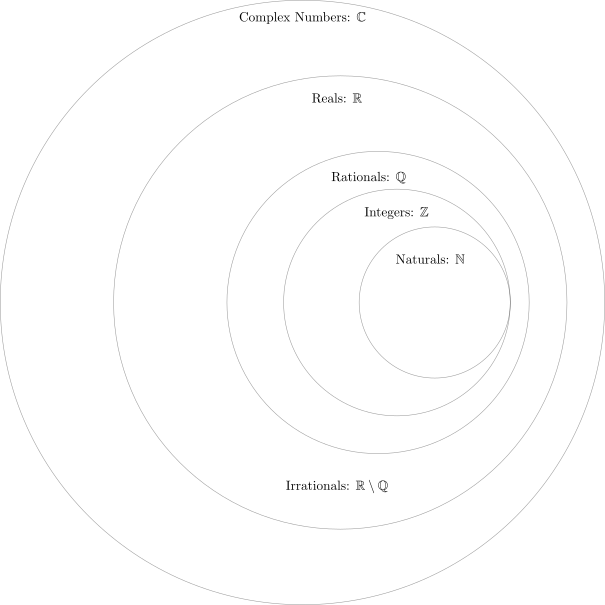
Finally, it is important to note how these numbers are interrelated, which is probably best captured through a Venn Diagram.
In particular, we want to note how each of these numbers fall into each other category (or not) - for example Natural Numbers are
also integers, rational numbers, real numbers, and complex numbers, but not irrational numbers. The video embedded video above
has a nice visual of this, which we also include below:
Conclusion:
In this segment we have covered the six common types of numbers that we will be using this semester, with one of them -
Complex Numbers - being the only one that we will be explicitly covering later in the semester. We discussed how to know if a
number is a member of each of these groups, and how each type of number may (or may not) automatically be a member of one of
the other groups of numbers.
 Precalculus Algebra