Je bent je ingevulde velden bij deze pagina aan het verwijderen. Ben je zeker dat je dit wilt doen?
You are erasing your filled-in fields on this page. Are you sure that is what you want?
Nieuwe Versie BeschikbaarNew Version Available
Er is een update van deze pagina. Als je update naar de meest recente versie, verlies je mogelijk je huidige antwoorden voor deze pagina. Hoe wil je verdergaan ?
There is an updated version of this page. If you update to the most recent version, then your current progress on this page will be erased. Regardless, your record of completion will remain. How would you like to proceed?
This section describes the geometry and useful symmetry of even functions, as well as
how to test for them analytically.
There are certain properties that turn out to be really helpful and exploitable -
especially in physics and calculus courses. We discuss one of these here, the so-called
“even” functions.
Lecture Video
_
Text and details
There are two main ways to try and understand the “even property”, and it comes
down to the fact that it is essentially a type of symmetry. We begin with the
geometric view - explicitly discussing the symmetry, and then continue on to the
analytic view to nail down the corresponding algebraic property, which will
ultimately give us the formal definition.
Geometric Perspective
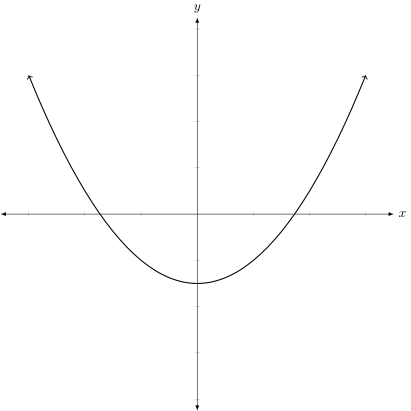
Consider the following graph:
Here we have the classic parabola, but for a moment ignore the math that you know
and just look at the picture of the curve. It has a pleasing smoothness and it is
perfectly centered horizontally - indeed we could imagine carefully folding along the
-axis and watching as the lines match up with a satisfying precision, overlapping
perfectly.
This kind of symmetry is called axial symmetry. The -axis is our line of symmetry
and if we rotate the picture around it 180 degrees, we get the same exact image
back. This is a general geometric property, but for the symmetry to be a
result of the “even property”, we need that the line of symmetry must be
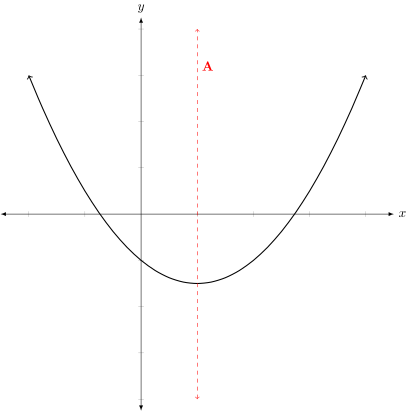
the -axis. This is the case in our previous graph, but consider the following
graph:
Although this is essentially the same curve, just shifted to the right slightly, we can’t
say that this graph has the “even property” because the line of symmetry has moved.
To be clear, we could say that this function is “symmetric about the line ” - but
this is not the same as saying that the “graph is even” or “has the even
property”.
Analytic Perspective
So now we can visualize the even property as axial symmetry about the -axis. But
how does this translate into an algebraic property that we can use to represent this
type of symmetry? Let’s return to our original example, but this time we draw only
the right half.
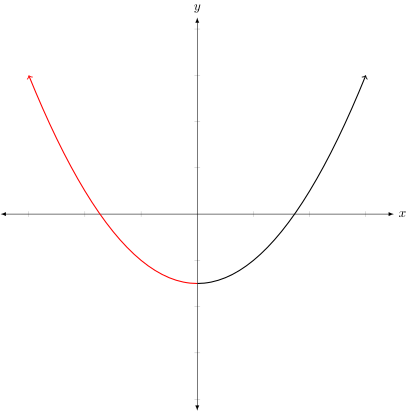
Now, on the one hand, we are missing half the graph, but on the other hand, we
know what the missing half should look like right? Thanks to the symmetry, we can
use the right half of the graph to produce the missing half - by simply copying what
we see on the right, over to the left:
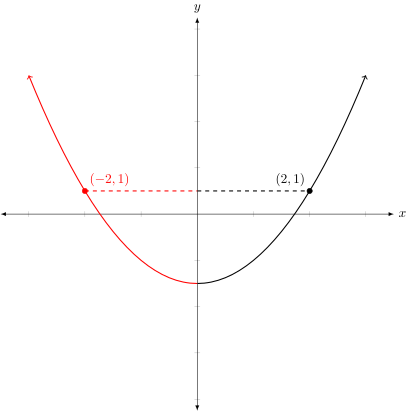
But, how does this get us closer to the algebraic property we want? Well let’s
consider what just actually happened. In essence, the points to the right of the -axis
are the same as the ones we are getting to the left of the -axis - the only difference is
that we are going left instead of right. In other words, if there is a point on the right
side somewhere (i.e. a point “” distance to the right and “” distance up), then
the point (i.e. “” distance to the left and “” distance up) is also on the
graph.
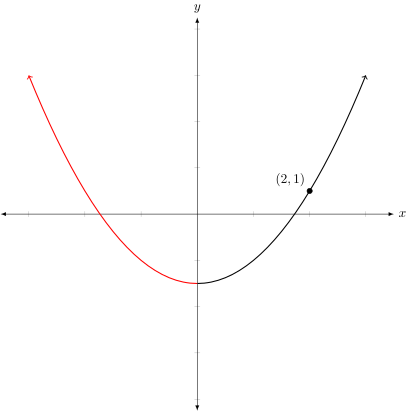
As a concrete version of this, consider our mirrored graph again, but let’s pick a point
to the right of the -axis somewhere - in particular we’ll choose and label
it.
Because of the symmetry, we know that a mirror point has to exist on the left side of
the -axis - which means that the value has to stay the same, and the value is the
same size, but in the other direction from the -axis.
This is the key observation - that we can flip the value (meaning the same size, but
the opposite direction) and the value remains the same. Importantly it doesn’t
actually matter which of the points we did this with either - we could have
started with the point and flipped the value to get which is still a point
on the graph. The key isn’t whether or not the value itself is positive or
negative - the key is that both the positive and negative version have the same
value!
This leads us to the analytic property for this kind of symmetry - that if is a point
on the graph, then the point must also be a point on the graph. It turns out, for
reasons that are beyond the scope of this course, we call functions with this type of
symmetry “even” functions, and this property is known as the “even property”.
Even
Function Let be a function. We say that is an even function if, for any ,
.
The definition is usually the part students remember (and it is indeed the useful
algebraic result), but the geometric understanding is usually easier to understand.
The real takeaway here is the idea that “if you go the same distance left or right from
the -axis, you get the same value.”
 Precalculus Algebra