Je bent je ingevulde velden bij deze pagina aan het verwijderen. Ben je zeker dat je dit wilt doen?
You are erasing your filled-in fields on this page. Are you sure that is what you want?
Nieuwe Versie BeschikbaarNew Version Available
Er is een update van deze pagina. Als je update naar de meest recente versie, verlies je mogelijk je huidige antwoorden voor deze pagina. Hoe wil je verdergaan ?
There is an updated version of this page. If you update to the most recent version, then your current progress on this page will be erased. Regardless, your record of completion will remain. How would you like to proceed?
This section describes one of the most important concepts in calculus - continuity!
One of the important properties of functions is continuity. Unfortunately we need
some calculus background to really dive into the nuts and bolts of continuity, but for
this course we will discuss continuity graphically, leaving the analytic view for first
semester calculus.
Lecture Video
_
Text and details
Continuity is often described as the ability to draw a graph “without picking up your
pencil”. What we really mean by this, is that there are no gaps in the curve - which
are called discontinuities (which we will discuss in a future segment). But there are
still many variations of how a function can be continuous. In this spirit, consider the
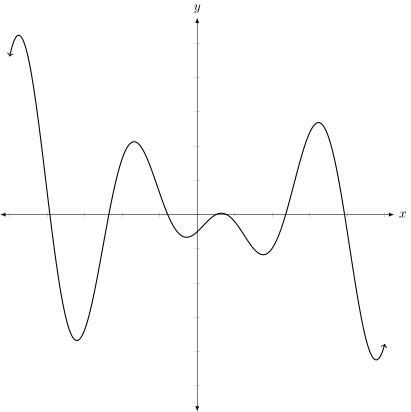
following graph:
This function looks kind of crazy, but notice that it is still continuous - indeed, there
are no gaps anywhere along the curve. Moreover, there is something else noteworthy
about this graph... it’s smooth. This seems like a subjective term, but in mathematics
it has real meaning (again the analytic nuts and bolts are beyond the scope of this
course, but we can get a feel for it visually!) Consider the following graph for
contrast:
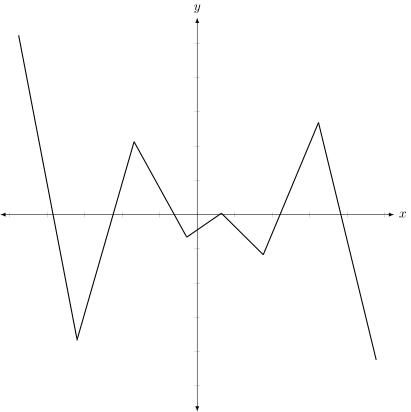
At first glance this graph is similar to our other one, but it looks... jagged.
Indeed, it has all kinds of points where the graph rapidly shifts direction - so
rapidly in fact that it creates a sharp corner. This is an example of a “not
smooth” function - in particular a “corner” is an example of something that is
continuous, but not smooth. For another example, consider the following
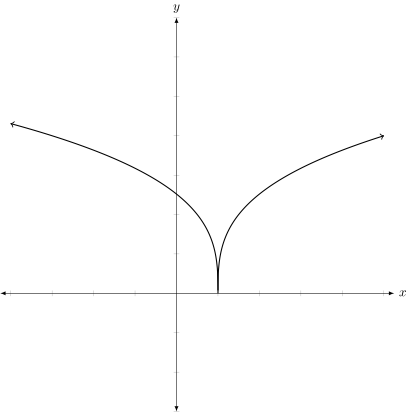
graph:
This is clearly continuous still, but it seems a little more spiky than a corner. Indeed,
this kind of point is called a cusp, and is the other classic example of a graph that is
continuous but not smooth.
Corners and cusps are the classic examples of continuous but not smooth points, and
are studied in greater detail in calculus. Nonetheless, it is worth being aware that just
because we know a function is continuous, it doesn’t necessarily mean that the
function is “nice” - it might still be jagged and spiky, but it’s at least all still nicely
connected without any gaps.
 Precalculus Algebra