Je bent je ingevulde velden bij deze pagina aan het verwijderen. Ben je zeker dat je dit wilt doen?
You are erasing your filled-in fields on this page. Are you sure that is what you want?
Nieuwe Versie BeschikbaarNew Version Available
Er is een update van deze pagina. Als je update naar de meest recente versie, verlies je mogelijk je huidige antwoorden voor deze pagina. Hoe wil je verdergaan ?
There is an updated version of this page. If you update to the most recent version, then your current progress on this page will be erased. Regardless, your record of completion will remain. How would you like to proceed?
Mathematical notation is designed to be as precise and concise as possible. There is a
downside to this however, which is that anything that has been studied in
mathematics for a very long time - like functions - tends to have remarkably dense
notation. This is the case for the notation.
Recall that a function is really a relation with context; the domain and codomain. We
established in the last section that a function “takes in an element of the domain and
outputs an element in the codomain”. Trying to write this out for every function we
want to work with would get tiresome and clunky, not to mention it lacks precision
(which is one of our chief goals!) so we establish the notation as a shorthand for this
(and much more).
There are many ways to approach the notation and it can get very technical. For
this class (and through calculus) we restrict ourselves to the two most common ways
it is used.
Defining the relationship between the input and output.
The most common use of notation is to define the relationship between the input
and output variable. This is what is being done when you see something like “”.
There are really three things being done here simultaneously.
a)
The first (and most obvious) is that we are giving the name of the function
that is relating the input and output variables; the “” in the .
b)
The second thing is that we are giving a name to a “dummy” input variable
(this is actually incredibly important as we’ll see soon), which in this case
is . This is the “” part of the .
c)
Lastly we are giving the relationship between the input (the ) and the
output by telling you how to transform the input into the correct output.
This is the “” part of the .
In this case it is important to notice that there is nothing special about the itself in
the expression ; it is just a dummy variable we are using because we need to use
something to represent the input. We could just as happily written or , or even ;
these are all the same function because they are all the same relationship. (we
also assume that all these have the same context, ie domain and codomain. In
particular, the only thing that changed is what symbol we call the representative
from the domain.)
This is easiest to understand if we consider a translation of the mathematical equality
in English. The function is (best) translated as “The function takes whatever input
you give it, squares that value, and then subtracts one from it.” Notice that I didn’t
need to give the input a name in the English version. This is because the specific
name “” didn’t matter, it was a placeholder name to represent “the input”, so I used
that phrase “the input” in the English translation instead of giving it a name like “”,
“” or “”.
Providing a naming scheme for the input and output.
The next most common way to see notation used, is to declare the names of the
independent and dependent variable. This is most commonly done with
an equality such as “”, but it is important to know that this is actually a
naming scheme. We are saying is a relation “taking in a point named ”
(thus we have named the independent variable “” here) and “it returns (or
maps to) a point named ” (thus we have named the dependent variable “”
here).
You may wonder, after we went through so much effort a couple paragraphs ago to
hammer the fact that the name we use for the input doesn’t matter - e.g.
we could use “”, “”, or even “”, so why are we now saying that this is a
naming scheme? In reality, both of these things are true - the name of the
input variable can be anything you want it to be - that’s what we mean
when we say we could use “”, “”, or even “”. On the other hand, we do need
to pick a name for the input. So even though it can be anything we want,
once we choose something, we are assigning the input a name that we can
reference later. So once we write down something like “”, from that point on
if we reference , it is understood that we mean the input for the function
.
This is most often used in preparation of some kind of graphical representation of
your function. For example you would want to say that before you present an -
graph of , otherwise the “” value has no meaning in the graph. We often take this
assignment for granted, but we can use this method for more complicated graphs.
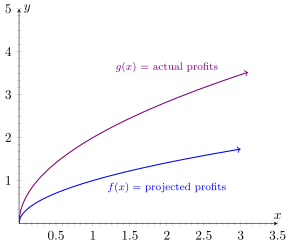
Consider figure profitProjections
Figure 1: As we see, the assignment for the output doesn’t have to be a variable
like “”. The shorthand for notation should only be used when it makes sense and
abandoned when it makes more sense to do something else - like how we leave
the function named and in this graph, rather than converting to something
like and .
What are the benefits to notation? (Select all that apply)
It is much denser,
saving a lot of time and space from writing out the words in English.It is purely
symbolic, so you can ignore the specifics of the real world aspects it models.The
notation provides the name and rule simultaneously.It facilitates a lot of other
mathematical mechanisms (eg composition, algebra, and precision.)It’s how the
notation has been defiend for millenia, so it helps understand historical work to
maintain the same notation.
What are the difficulties with notation? (Select all that apply)
The notation is
very dense, which makes it hard to read.The notation contains everything you need,
no more and no less.The notation is purely symbolic which obfuscates the context of
the situation being modeled.The notation doesn’t include some necessary
information like the relation between input and output.
What’s Next?
The real strength of notation is that it allows us to figure out what happens when
we modify the input before the function even takes place. This is called function
composition, which is what we will cover in the next section!
 Precalculus Algebra