Je bent je ingevulde velden bij deze pagina aan het verwijderen. Ben je zeker dat je dit wilt doen?
You are erasing your filled-in fields on this page. Are you sure that is what you want?
Nieuwe Versie BeschikbaarNew Version Available
Er is een update van deze pagina. Als je update naar de meest recente versie, verlies je mogelijk je huidige antwoorden voor deze pagina. Hoe wil je verdergaan ?
There is an updated version of this page. If you update to the most recent version, then your current progress on this page will be erased. Regardless, your record of completion will remain. How would you like to proceed?
What can be said about limits that have the form nonzero over zero?
Let’s cut to the chase:
A limit is said to be of the form if where is some nonzero constant.
1 : Which of the following limits are of the form ?
In our next example, let’s see what is going on with limits of the form .
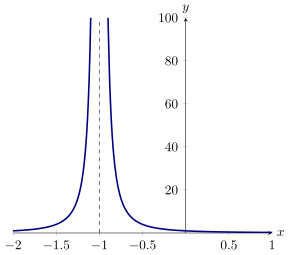
Consider the function Use a table of values to investigate .
Fill in the table below: What does the table tell us about It appears
that the limit does not exist, since the expression becomes larger and larger as approaches . So, as Moreover, as approaches
:
The numerator is positive.
The denominator approaches zero and is positive.
Hence, the expression will become arbitrarily large as approaches . We can see this in the graph of .
We are now ready for our next definition.
Below we give the formal definition, but in short we will say a (one sided) limit “equals infinity” (or negative infinity) when the
limit gets arbitrarily large and stays positive (or negative respectively). Also, just like with normal limits; if the left and right
limits both “equal” the same type of infinity, then we say the (two-sided) limit is infinity (or negative infinity
respectively).
If grows arbitrarily large (and stays positive) as approaches from the right, we write and say that the limit of is
infinity as approaches from the right.
If grows arbitrarily large (and stays positive) as approaches from the left, we write and say that the limit of is
infinity as approaches from the left.
If Then we write and say that the limit of is infinity as goes to .
If grows arbitrarily large (and stays negative) as approaches from the right, we write and say that the limit of is
infinity as approaches from the right.
If grows arbitrarily large (and stays negative) as approaches from the left, we write and say that the limit of is
infinity as approaches from the left.
If Then we write and say that the limit of is negative infinity as goes to .
Note: Saying “the limit is equal to infinity” describes more precisely the behavior of the function near , than just saying ”the limit
does not exist”.
Let’s consider a few more examples.
Compute:
First let’s look at the form of this limit. We do this by taking the limits of both the numerator and
denominator: So, this limit is of the form . This form is determinate, since it implies that the limit does not
exist. But, we can do better than that! As approaches :
The numerator is a positivenegative number.
The denominator is positivenegative and is approaching zero.
This means that
Compute:
First let’s look at the form of this limit, which we do by taking the limits of both the numerator and denominator. This
limit is of the form . Next, we should factor the numerator and denominator to see if we can simplify the problem at all.
Canceling a factor of in the numerator and denominator means we can more easily check the behavior of this limit. As approaches
from the right:
The numerator is a positivenegative number.
The denominator is positivenegative and approaching zero.
This means that
Here is our final example.
Compute:
We’ve already considered part of this example, but now we consider the two-sided limit. We already know that and
that this limit is of the form . We also know that as approaches from the right,
The numerator is a negative number.
The denominator is positive and approaching zero.
Hence our function is approaching from the right.
As approaches from the left,
The numerator is negative.
The denominator is negative and approaching zero.
Hence our function is approaching from the left. This means We can confirm our results of the previous two examples by looking
at the graph of :
Some people worry that the mathematicians are passing into mysticism when we talk about infinity and negative infinity. However,
when we write all we mean is that as approaches , becomes arbitrarily large and becomes arbitrarily large, with taking negative
values.
 Survey of Calculus One - Limits