Je bent je ingevulde velden bij deze pagina aan het verwijderen. Ben je zeker dat je dit wilt doen?
You are erasing your filled-in fields on this page. Are you sure that is what you want?
Nieuwe Versie BeschikbaarNew Version Available
Er is een update van deze pagina. Als je update naar de meest recente versie, verlies je mogelijk je huidige antwoorden voor deze pagina. Hoe wil je verdergaan ?
There is an updated version of this page. If you update to the most recent version, then your current progress on this page will be erased. Regardless, your record of completion will remain. How would you like to proceed?
We discuss to actually apply linear approximation to approximate a value.
Video Lecture
_
Text and Additional Details
We have an intuition of what linear approximation is trying to do, and now we will discuss the technical aspects. We will present a
number of notations and vocabulary common to this subject, and introduce the variations of the formula using these different
notations.
We know that linear approximation is the process of using a (nearby) easy to calculate input and a tangent line to approximate the
value of a difficult to calculate input. For example, if we wanted to calculate we could use the function and the easy-to-compute
value , then take a derivative to get the slope of the tangent line, which allows us to find an approximation for . But a worthwhile
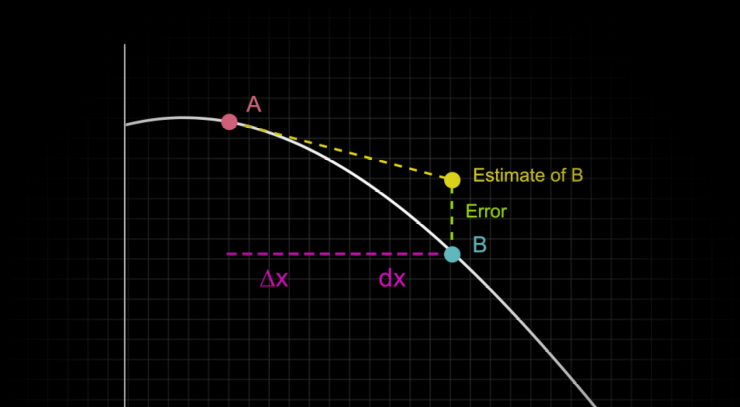
question would be: can we sum up this algorithm into a single formula? Let’s motivate our analytic process with the following
picture:
Here, point is the easy to calculate point that we use as our starting point, and is the point we want to estimate. We can see that
our estimation is represented by the dashed line moving from the value to the value.
But how do we represent the process of “traveling along the tangent line”? Remember that the tangent line is (itself) a formula. So
if we could find a formula for that tangent line, then we could actually plug in to the formula and that would give us our estimate!
But we’ve already done tangent lines, so this isn’t anything new! Indeed, we know that the slope of the tangent line is just the
derivative at that point (which is ) and the point itself (which is ). So we can use the slope-point form of a line to get our formula; .
Thus, if we want to evaluate this formula at we get: The key takeaway here though, is that this formula is nothing special or
unique, it’s just the tangent line formula at the point applied specifically to the point . In some sense, we could
just as easily say that “linear approximation” is simply an application of “tangent lines”. It’s mostly because it
ends up being so useful virtually everywhere in the worlds of engineering and science that it ends up with its own
name.
1 : Linear approximation is...
Very useful, so we developed a special formula to represent the idea.Relatively straight
forward (pun intended) but due to it’s many applications there is no real formula for it.Just an application of tangent lines -
where is the -value that is easy to calculate and is the -value that we want to estimate.Just another application to memorize and
forget - who really uses it anyway?
It is worth taking a moment to see the other common way this formula is often recorded. Again I want to stress that this is more
due to context, discipline, and/or notational choices of the author or instructor as to which notation is used, but they all mean the
same thing.
Differential Form:
In some calculus courses or settings, this subject is taught using the idea of a “differential”. The
differential is, essentially, the small change in the and/or direction that we discussed when we first introduced the
idea of instantaneous rates of change. In this context, the differential represents the distance between the points
and , and is usually denoted by either or . So we would have the formula:
So we’ve seen that linear approximation, although incredibly useful in just about every area of science, is actually nothing more
than the application of a tangent line to get an estimate of a difficult-to-calculate value of a function, assuming you
have an easy (or easier) to compute value nearby. This formula has different common forms, but the notation and
vocabulary all represent the same idea, just different contexts and discipline conventions result in different forms for this
idea.
 Survey of Calculus One - Limits