Je bent je ingevulde velden bij deze pagina aan het verwijderen. Ben je zeker dat je dit wilt doen?
You are erasing your filled-in fields on this page. Are you sure that is what you want?
Nieuwe Versie BeschikbaarNew Version Available
Er is een update van deze pagina. Als je update naar de meest recente versie, verlies je mogelijk je huidige antwoorden voor deze pagina. Hoe wil je verdergaan ?
There is an updated version of this page. If you update to the most recent version, then your current progress on this page will be erased. Regardless, your record of completion will remain. How would you like to proceed?
We discuss how to find and evaluate absolute extrema of a function using derivatives.
Video Lecture
_
Text and Additional Details
Local extrema can be very useful as we’ve discussed, but often you want the best of the best - the absolute extrema. Fortunately
these are found in almost the exact same way as the local extrema... almost.
For most applications, absolute extrema are simply the local extrema that is the largest (or smallest, depending on what you are
looking for) and so finding absolute extrema is simply the process of finding all the local extrema and determining their
values, then determining which one is the largest maximum, or lowest minimum. There are two exceptions to this
however.
First, we need to determine if there actually are absolute extrema. This is the easiest part to overlook or forget. Indeed a common
error is to get so focused on finding the critical points and local extrema values, that one forgets to check if it is even
necessary.
To determine if there are absolute extrema, we need to determine the range of the function (or more accurately, whether there is an
upper or lower bound). This is accomplished by looking for vertical asymptotes, and horizontal asymptotes of the function
(if applicable). Note that horizontal asymptotes can only occur in a direction where the domain goes infinitely
far.
If, on the other hand, we have a bounded domain like for some real numbers and , then we don’t have to worry about horizontal
asymptotes, i.e. end term behavior. Indeed, if the interval is closed and the function is continuous, it turns out we must have an
absolute extrema, which is the extreme value theorem - discussed in another segment.
1 : If your function doesn’t have a bounded range - like if it has vertical asymptotes and the function approaches both
positive and negative infinity, what does that mean about absolute extrema?
You need to take a derivative to find the
absolute extrema.There is only one absolute extrema, but you won’t know which until you find and test it.There are no absolute extrema.Nothing - this entire page is a psy-op campaign designed to break my spirit.
If we don’t have any vertical asymptotes, and if we can determine that the horizontal asymptotes are finite (or the domain is
bounded) then we can go ahead and look for the local extrema and determine their -values. This is where the second exception
comes into play - whether or not the function is defined on a closed interval.
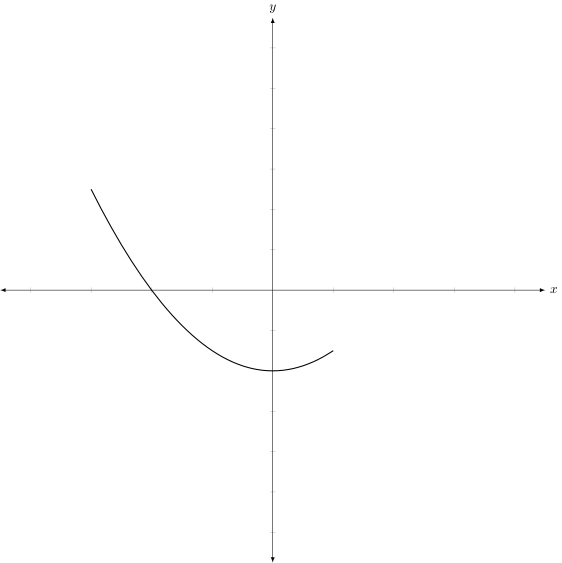
If the function’s domain is indeed a closed interval, then we need to test the endpoints of the domain. Let’s see an
example: consider the function , but suppose we restrict the domain to the interval . Then the graph would look like
this:
If we take the derivative we can see that we get which has a single critical point at . Testing this one point gives us a local
minimum at which is also the absolute minimum. But... our graph shows that we should have found two potential maximums, but
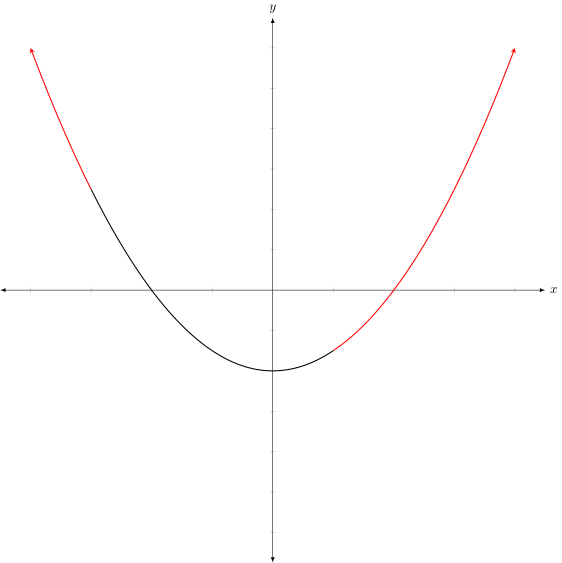
they didn’t show up? Why not? The answer lies in seeing a little more of the graph.
Here we’ve added a little more of the function in red to show why the derivative didn’t detect the endpoints of the original graph
as critical points. Indeed, mathematically there is no reason to think there should be maximums at those values
because the function would normally continue on right through them; it’s the restricted domain that causes us to
have potential extrema that we need to check. For this reason, whenever you have a closed endpoint, you should
check that value as well against your list of local extrema to see if it is potentially the absolute extrema you want.
Notice that an open endpoint need not be checked because an open endpoint is, by definition, not included in the
original graph... so it’s not a valid value attained by the function on it’s defined domain and thus can’t be an
extrema.
2 : When checking for absolute extrema you should find and test all the local maximums and minimums, as well as...
Any
(closed) endpoints of the domain of the function.Any horizontal asymptote values.Any vertical asymptote values.Nothing... the
cake is a lie.
So, as we’ve seen, the process of finding absolute extrema is essentially the same as finding local extrema, with the exception
that you need to check two things first. The first is whether or not the function has absolute extrema, which you
check by looking for vertical asymptotes and horizontal asymptotes (to determine if the range of the function is
infinite in one or both directions). The second thing to remember is that, if the function has a closed endpoint, you
need to check that endpoint’s value as if it were an extrema because it almost certainly won’t register as a critical
point.
 Survey of Calculus One - Limits