Je bent je ingevulde velden bij deze pagina aan het verwijderen. Ben je zeker dat je dit wilt doen?
You are erasing your filled-in fields on this page. Are you sure that is what you want?
Nieuwe Versie BeschikbaarNew Version Available
Er is een update van deze pagina. Als je update naar de meest recente versie, verlies je mogelijk je huidige antwoorden voor deze pagina. Hoe wil je verdergaan ?
There is an updated version of this page. If you update to the most recent version, then your current progress on this page will be erased. Regardless, your record of completion will remain. How would you like to proceed?
Let’s say we are trying to determine the limit of as approaches . It turns out considering values “near ” is a little too vague.
Instead, it helps to break the neighborhood around into two regions, the values just to the left of (i.e. slightly less than or slightly
more negative than ) and the values just to the right of (i.e. slightly larger than or slightly more positive than ). This is the
concept of a one-sided limit!
Geometric definition of one-sided limits A left limit, also called a limit “from the left” is the value being approached by -values
approaching our point of interest (in the case above, ) from below (a.k.a. values to the left on the numberline).
A right limit, also called a limit “from the right” is the value being approached by -values approaching our point of interest (in
the case above, ) from above (a.k.a. values to the right on the numberline).
We will introduce the formal notation in the next section, but for now let’s see some examples.
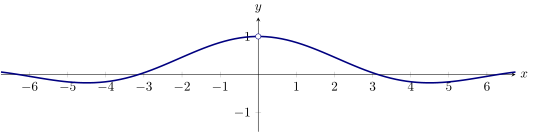
Recall the graph from our previous section:
Here, if we consider the values as approaches from the left, we can see that approaches...
Cannot be determined, since
is not defined.Any number is valid since the function is not defined at and thus we can make it anything.
From this setting we come to our definition of a limit.
Intuitively, the limit of as approaches is , if the value of is as close as one wishes to for all sufficiently close, but not equal to,
.
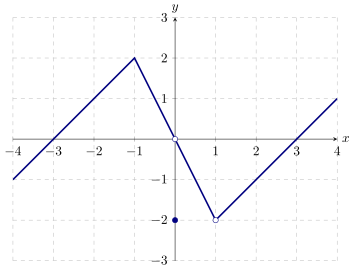
Consider the following graph of
Use the graph to evaluate the following. Write DNE if the value does not exist.
(a)
(b)
The limit as approaches is
(c)
(d)
The limit as approaches is
(e)
(f)
The limit as approaches is
(g)
(h)
The limit as approaches is
Limits might not exist
Limits might not exist. Let’s see how this happens.
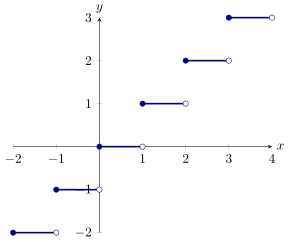
Consider the graph of the floor function, .
Explain why the limit as approaches of does not exist.
The function , called the “floor” function, is the function that returns the
greatest integer less than or equal to . Now recall that, intuitively, we know a limit exists at if there exists some number so that
can be made arbitrarily close to by making sufficiently close, but not equal to, . So let’s examine near, but not at, , and see if we
can find such an ?
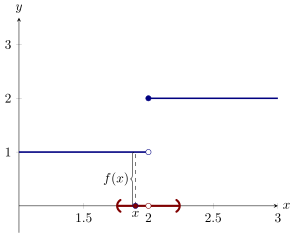
If this limit exists, then we should be able to look sufficiently close, but not at, , and see that is approaching some number. Let’s
look closer at the portion of our graph near our point:
If we allow x values on the left of 2 to get closer and closer to 2, we see that . However, if we allow the values of on the right of 2
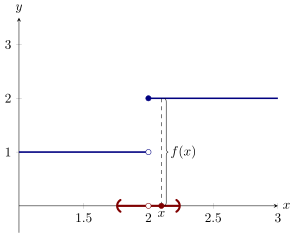
to get closer and closer to 2...
We see that for all these values just to the right. We cannot find a single number that approaches as approaches 2! In essence,
since the left limit () and the right limit () are not going to the same place, the limit at cannot exist, because we can’t get a single
value for our definition.
You may have noticed that in our example above, the function is also discontinuous at that point. It turns out this is true in
general! We will explore the relationship between continuity and limits a little later (including finally giving a formal definition of
continuity, rather than our intuitive definition we’ve had since before precalculus!) but for now we state the following useful
result:
Continuity implies limit exists If a function is continuous at the value , then the limit at exists, and equals
.
If you don’t recall what it means to be “continuous at ”, click the blue arrow to the right!
You can intuitively think of a function being continuous at a point, as meaning that there isn’t a discontinuity at that
point. You can review types of discontinuities and what they mean here (You should open the link in a new tab!).
The actual justification/proof for the above theorem will be covered when we dive deeper into continuity, but this result will allow
us to investigate many useful examples in the meantime.
 Business Calculus One