Je bent je ingevulde velden bij deze pagina aan het verwijderen. Ben je zeker dat je dit wilt doen?
You are erasing your filled-in fields on this page. Are you sure that is what you want?
Nieuwe Versie BeschikbaarNew Version Available
Er is een update van deze pagina. Als je update naar de meest recente versie, verlies je mogelijk je huidige antwoorden voor deze pagina. Hoe wil je verdergaan ?
There is an updated version of this page. If you update to the most recent version, then your current progress on this page will be erased. Regardless, your record of completion will remain. How would you like to proceed?
We introduce the notation and formal algebraic definitions for limits.
Video Lecture
_
Limit Notation
You may have noticed at this point that it can get cumbersome and tiring to keep saying the phrase “the limit of as approaches ”
and mathematicians are inherently lazy, so we have defined a notation that encapsulates this entire phrase, which we present
next.
We start with a definition:
Limit Notation If the limit of as approaches is (according to our intuitive definition), then we write
this as;
This notation breaks down the limit information we need into neat little blocks, which we will pull apart and parse
here.
The at the start tells us we’re dealing with a limit (I said mathematicians were lazy, not creative!).
Underneath (or sometimes a subscript in front) of the is “”. This block is telling us that the value is approaching
the value , which is where the limit is happening. In other words is the “-value of interest”.
Notice that the whole block is saying “the limit, as approaches of...” Thus the is the thing that the limit is being
computed for. You can think of the as full brick of notation that is then applied to a function. This means it makes
no sense to write this thing on its own, it inherently must be applied to something.
Finally, the part is just telling us that the thing on the left of the “” sign (the limit as approaches of ) is the same
value as , which is the very wordy way of saying that the limit is .
The notation above is pretty dense and something that we will be using a lot. Take a few moments to really digest what the
notation means. What would it mean to change the value? How about the value, or ? Make sure you understand the
notation well before moving forward as we will be adding a couple more notational bits which are subtle, but very
important.
One-sided Limits
Thus far we have used tables and graphs to determine limits, and we’ve discussed the possible up and downsides of both. Our next
goal is to formalize the analytical idea of the limit; which requires the introduction of the one-sided limit. Recall that it can be
helpful to break the region near our point of interest into the (nearby) region to the left of and the (nearby) region to the right of .
We formalize the notation for these left and right limits next.
We start with a definition:
For the function , is the limit from the right as approaches , written if the value of is as close as
one wishes to for all sufficiently close to .
Similarly, for the function , is the limit from the left as approaches , written if the value of is as close as one wishes to for all
sufficiently close to .
Recall that a limit exists at and equals if; for values sufficiently close to , gets as close as we want to . But notice this is
equivalent to saying that both the left and right limits are equal to the same value; namely to . In other words, a limit
exists if, and only if, both one-sided limits exist, and have the same value! We formalize this idea in the following
theorem.
A limit exists if and only if
exists
exists
In this case, is equal to the common value of the two one sided limits.
If the theorem above doesn’t look like what you remember from another class or textbook, click the blue arrow to the right for a
note on how this is often presented in other textbooks/lectures!
Often in literature (like textbooks or notes) you will see the above theorem written as the following:
The limit exists and equals if
Notice that this is actually the same thing, but this definition is a little less clear. Specifically
and
can only equal L (and each other) if they exist. So this definition is hiding the fact that you need to check if the one sided
limits exist in the first place by burying it as an assumption into the equality. You can use either definition (they
are equivalent after all), but remember that this second definition has more going on than first meets the eye!
Suppose you are taking a quiz or an exam and one of the problems gives you a function , then asks you to figure out if exists, and
if it exists, to calculate its value.
You should start by...
Graphing the function.Determining the value of the function at .Calculate both one-sided limits of at .Calculate one of the one-sided limits of at .calculate at .
Next you...
Conclude that the limit exists.Check to see if the two one-sided limits equal each other.Conclude the limit DNE.Calculate .Conclude the value of the limit.
If the limits agree (i.e. both limits equal some )...
You may conclude the limit DNE.You can’t conclude if the limit exists or not,
nor its value.You can conclude the limit exists, but not its value.You can conclude the limit exists and its value.
In particular the limit is equal to...
The value of the one-sided limit, i.e. ..You can’t know from the information you have so
far.
If the limits don’t agree...
You may conclude the limit DNE (Does Not Exist).You can’t conclude if the limit exists or not, nor
its value.You can conclude the limit exists, but not its value.yYou can conclude the limit exists and its value.
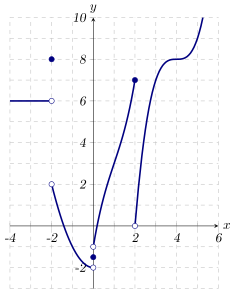
Evaluate the expressions by referencing the graph below. Write DNE if the limit does not exist.
(a)
(b)
(c)
(d)
(e)
(f)
(g)
(h)
(i)
(j)
(k)
(l)
Optional Content
If you are interested in how mathematicians actually prove a limit’s value rigorously you can watch the following video on how
mathematicians tackle the problem of testing all nearby points simultaneously. [URL to YouTube video, but not an embedded
video.]