Je bent je ingevulde velden bij deze pagina aan het verwijderen. Ben je zeker dat je dit wilt doen?
You are erasing your filled-in fields on this page. Are you sure that is what you want?
Nieuwe Versie BeschikbaarNew Version Available
Er is een update van deze pagina. Als je update naar de meest recente versie, verlies je mogelijk je huidige antwoorden voor deze pagina. Hoe wil je verdergaan ?
There is an updated version of this page. If you update to the most recent version, then your current progress on this page will be erased. Regardless, your record of completion will remain. How would you like to proceed?
We discuss how to determine where a function is concave up or concave down.
Video Lecture
_
Text and Additional Details
So we know generally what concavity is, and what it looks like, but how do we determine concavity of a function? In precalculus you likely
discussed how to determine concavity from a graph, but what about when your function is too complicated to easily graph? This is what
we tackle here.
Concavity can be best thought of as a force pulling at the graph trying to bend it in either the positive direction (for concave up) or the
negative direction (for concave down). Importantly, this doesn’t necessarily (and in fact often doesn’t) correlate with the function being
increasing or decreasing - meaning that the function can be increasing and concave up or down, and same for if the function is decreasing.
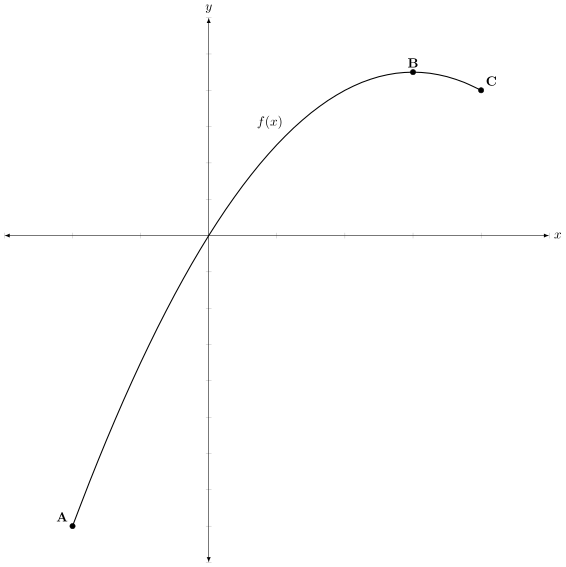
Let’s see an example:
Notice that, for the entire span from A to B, the function is increasing - but also concave down. So as we can see, even though the
function is increasing, the concavity is effecting how fast it increases. In particular, the rate at which the function is increasing is getting
smaller and smaller. In essence the concavity is overpowering the rate the function is increasing. This observation, that concavity can be
viewed as the rate of change of the function’s rate of change leads us to our algebraic breakthrough. The concavity is the derivative of the
derivative, a.k.a. the second derivative.
Before we state the rules for concavity it is worth taking a moment to clarify the notation often used for derivatives, and especially taking
multiple derivatives (also referred to as ’higher derivatives’).
Higher Derivative Notation When taking multiple derivatives there are several ways to notate repeated derivatives. In particular, if we
wish to take multiple derivatives of we may denote this as:
(a)
This is the second derivative of and is by far the most common way to write a second derivative.
(b)
This is the third derivative of . This is about as common as the next form for writing a third derivative.
(c)
This is the derivative. For example writing a third derivative in this format would be . Note that the parentheses around
the exponent number are actually necessary here.
(d)
This is the derivative of . For example writing the third derivative in this format would be . This format is mostly used
when dealing with multivariable functions for reasons that are beyond the scope of this course.
Also note that all of these forms also apply to the first derivative, i.e., , [which is never actually used], and are all “the first derivative of
with respect to .”
Now that we have the notation, we can state our second derivative result for concavity.
Let be a second differentiable function (i.e. the first and second derivative exist) on the interval . Fix such that . Then:
If , is concave up at .
If , is concave down at .
The above is a little dense, but let’s parse it into human speak. Essentially what the theorem says is that, as long as the second
derivative makes sense at a point, then you can use the sign of the second derivative at that point to determine the
concavity at that point. So, if you had the function , then you could take the second derivative to get and then plug
in a number, like to determine the concavity at - in this case . Since , we know that the function is concave up at
.
So we have seen that concavity is really a way to measure the rate of change of the rate of change. In other words, concavity is measured
using the second derivative. We outlined the common notation used for higher derivatives, and saw an example of computing the
concavity at a point of a simple problem. There are separate example videos with more demonstrations and other types of concavity
problems.
 Business Calculus One