Je bent je ingevulde velden bij deze pagina aan het verwijderen. Ben je zeker dat je dit wilt doen?
You are erasing your filled-in fields on this page. Are you sure that is what you want?
Nieuwe Versie BeschikbaarNew Version Available
Er is een update van deze pagina. Als je update naar de meest recente versie, verlies je mogelijk je huidige antwoorden voor deze pagina. Hoe wil je verdergaan ?
There is an updated version of this page. If you update to the most recent version, then your current progress on this page will be erased. Regardless, your record of completion will remain. How would you like to proceed?
We present the first fundamental theorem of calculus
So far we have discussed definite and indefinite integrals as separate things - definite integrals as the perfect approximation of the signed
area of a region bounded by some curve and the -axis, on an interval - and the indefinite integral as the class of all possible
antiderivatives to a given function. But it turns out, these two seemingly completely unrelated ideas are actually the
same thing! This is the fundamental theorem of calculus, which has two parts. We introduce and discuss the first part
here.
Video Lecture
_
Text with Additional Details
We originally discussed the indefinite integral as the process of trying to reverse a derivative. This means, if indefinite and definite
integrals really are the same thing, then there should be a way to relate the definite integral to the derivative process. And, indeed, there
is! This is the first fundamental theorem of calculus. Before we can state the theorem however, we need to make a small intuitive leap,
which warrants a bit of explanation.
The purpose of the Fundamental Theorem of Calculus is...
To show that the definite and indefinite integrals are really the same thing.To give us easier ways to compute difficult integrals.To sum up what we’ve learned in calculus into a nice neat theorem.To generate
even more annoying math problems for us to do on exams.
To this point, we have discussed the definite integral using concrete values for bounds - that is, bounds that are actual numbers. But
strictly speaking, there is no reason we have to do that... instead we could put non-constants as bounds. To this end, suppose we have a
function (that has an antiderivative, i.e. is integrable) , and consider the definite integral:
The lower bound is some constant number as normal. However, the upper bound is a variable. The definite integral is a way of
determining the area under a curve on the given interval, but now the upper bound of that interval is a variable, - what gives? Well, this
means that the “upper bound” is now something we can put in as a value, just like any other variable. This means that the area will
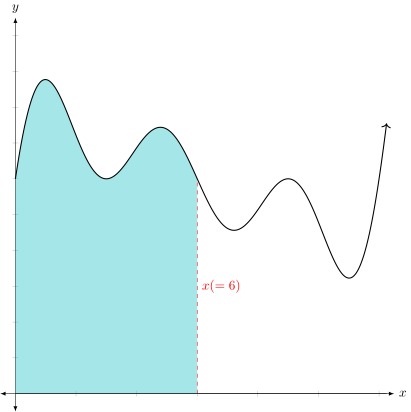
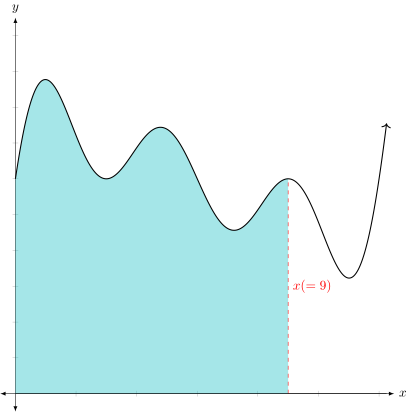
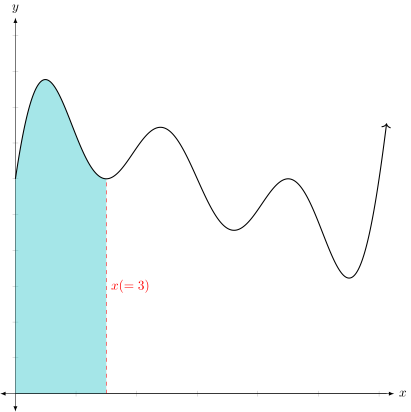
inherently change as we change the value of . It helps to visualize what this means, and to that end let’s consider some graphical
examples...
We can see that, as changes, the area of the shaded region also changes, so in some sense we can think of the total area of this definite
integral as being some kind of function of . Indeed, if we were to calculate the definite integral, because one of the bounds has an , we
know that the resulting area would have to also have an , and thus it is dependent on a.k.a., a function of . With this in mind, we can
now state the first fundamental theorem of calculus.
First Fundamental Theorem of Calculus (FTC I): Let be an integrable function, and fix . Further suppose there exists some function
such that: Then .
As usual, we will translate the theorem into human speak. Essentially this first fundamental theorem is telling us that if we take the
definite integral of some function from any real number () to and represent that area as a function called , it turns out that is an
antiderivative of . In other words, the (in principle, unknown) function, , that represents the area as a function of , is actually the
antiderivative of the integrand.
This gives us the first of our links between indefinite and definite integrals. Indefinite integrals were the antiderivatives, but now we have
antiderivatives showing up in a definite integral situation. What’s more, this gives us a nice way to represent the area of a region, at least
when it is in the form of a function of .
The first fundamental theorem of calculus is important because...
It lets us calculate definite integrals faster.It relates the definite and
indefinite integrals by showing that definite integrals can be computed by an antiderivative.It helps us get the second fundamental
theorem, which is the only important one.It isn’t. This is all a trick!
 Business Calculus One