Je bent je ingevulde velden bij deze pagina aan het verwijderen. Ben je zeker dat je dit wilt doen?
You are erasing your filled-in fields on this page. Are you sure that is what you want?
Nieuwe Versie BeschikbaarNew Version Available
Er is een update van deze pagina. Als je update naar de meest recente versie, verlies je mogelijk je huidige antwoorden voor deze pagina. Hoe wil je verdergaan ?
There is an updated version of this page. If you update to the most recent version, then your current progress on this page will be erased. Regardless, your record of completion will remain. How would you like to proceed?
We discuss how to use the second derivative to classify extrema of a function.
Video Lecture
_
Text and Additional Details
We have seen that one way of finding local extrema is to find critical points and then use a sign graph to determine which of those points
might be maximums, minimums, or neither. It turns out there is another way we can do this as well, called the “second derivative test”.
This can be useful in circumstances where it is difficult to tell the sign of a derivative, or if you already know a critical point and only
want to know if that specific point is a max, min, or neither.
The second derivative test is actually fairly easy to state, although the “why it works” bit can be a bit opaque at first glance. Simply put
the second derivative test says the following:
Second Derivative Test Let be a differentiable function on some interval . Further suppose that there is an -value such that .
Then:
if , i.e. the second derivative at is strictly positive, then is a minimum.
if , i.e. the second derivative at is strictly negative, then is a maximum.
Essentially the second derivative test says that, if you have a critical point, you can test whether it is a maximum or minimum by
plugging that value into the second derivative (hence the name). If it is a positive number, then it is a minimum. If it is a negative
number, then it is a maximum.
It is very important to notice here that the second derivative test says nothing about what happens if the second derivative
is zero! This leads to an incredibly common mistake - often one intuitively thinks that, if you plug in the critical point
into the second derivative and you don’t get a positive number, then the value can’t be a minimum (or similarly for
negative number and maximum) but this is not true! If you plug in the critical number and get zero, then the test is
said to fail at that value - meaning you need to find another way to determine what is happening. Let’s see some easy
examples.
Has derivative and critical point .
Plugging in to we get which is positive.
So the point is a local minimum.
Has derivative of and critical point
Plugging in to we get .
Thus the second derivative test failed!
Indeed, recalling the graph of we know that there is no local extrema at .
Has derivative of and critical point
Plugging in to we get .
Thus the second derivative test failed!
Now though, recalling that this still looks like a parabola, the value is a local minimum.
If you know that for some , then you can use the second derivative to...
Determine whether is a maximum or minimum.Determine
whether is a maximum or minimum.Determine whether is a maximum or minimum.Slowly lose your sanity until you don’t care
anymore...
If then...
is definitely not a maximum. is definitely not a minimum.The test failed, you don’t know anything.Ask someone else,
clearly this problem is designed to screw with you.
So, we know that the second derivative test can tell us if a critical point is a maximum or minimum, but it can also fail. But why do we
know that the second derivative being positive or negative means that the function is a minimum or a maximum respectively? This is
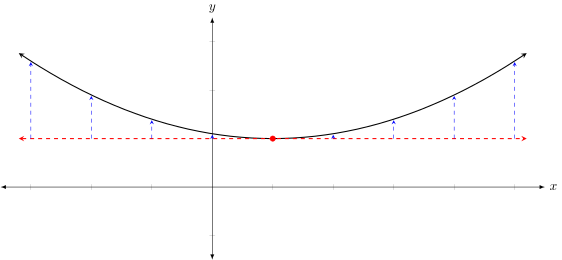
because of our good friend concavity! Recall that the second derivative determines the concavity of a function: if the second derivative is
positive then the function is concave up - meaning that it is “bending upward, away from the tangent line”. But if you envision that the
tangent line is horizontal (which it must be at a critical point!) then bending up and away means that you are forming an upward cup,
where the tangent point (which is the point we are testing - the critical point) is then the “bottom” of the cup. Like
this:
As we can see, the concavity is “bending” the curve up and away from our tangent point (the red dot). As a result, the tangent point is a
local minimum; so a strictly positive concavity where the tangent line is horizontal (a critical point) results in a local
minimum!
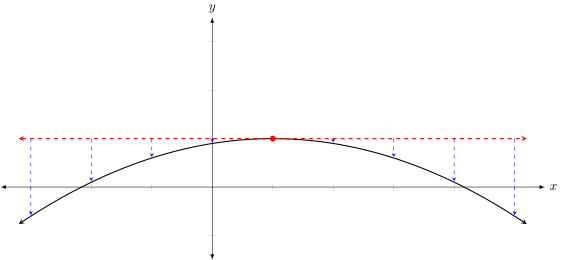
Similarly we can see the same situation arises for the local maximum (albeit with a negative concavity):
The second derivative test uses...
Concavity to determine whether a function is increasing or decreasing.Concavity to determine
whether a point is a local maximum or minimum.The sign of the first derivative to determine if a point is a critical point.The force.
The force is strong with this one.
So, we have another tool in our toolbox for classifying local extrema, the second derivative test. In this case though, we need to remember
that, although it can be a quick and powerful tool to find out if a function has a local max or min at a critical point, the test can also
fail. Getting a zero at a critical point for the second derivative tells us nothing - the value might be a max, a min, or
neither. Nonetheless, the second derivative test can be a speedy way of determining the nature of critical points in many
circumstances.
 Business Calculus One