
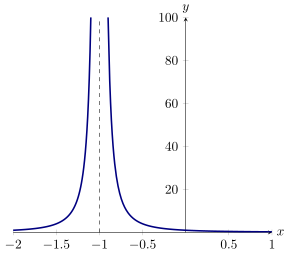
On the other hand, consider the function
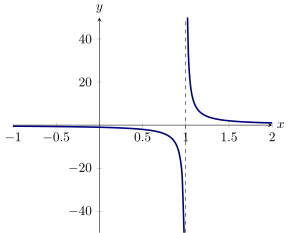
Find the vertical asymptotes of
Since is a rational function, it is continuous on its domain. So the only points where the function can possibly have a vertical
asymptote are zeros of the denominator.
Start by factoring both the numerator and the denominator: Using limits, we must investigate what happens with when and , since and are the only zeros of the denominator. Write 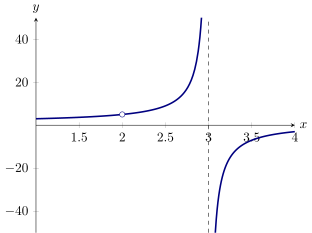 Hence we have a vertical asymptote at .
Start by factoring both the numerator and the denominator: Using limits, we must investigate what happens with when and , since and are the only zeros of the denominator. Write
Now write
Consider the one-sided limits separately.
When , the quantity is positive and approaches and the numerator is negative, therefore, .
On the other hand, when , the quantity is negative and approaches and the numerator is negative, therefore, .