You are about to erase your work on this activity. Are you sure you want to do this?
Updated Version Available
There is an updated version of this activity. If you update to the most recent version of this activity, then your current progress on this activity will be erased. Regardless, your record of completion will remain. How would you like to proceed?
Mathematical Expression Editor
A pair of examples extending right triangle tools to non-right triangles.
We will now extend our techniques for understanding right triangles to understand
non-right triangles. The following two problems will provide a walk through
for how to find right triangles that we can use in a picture of an arbitrary
triangle.
1 : We will first find the missing sides and angles of the triangle below given
that , , and assuming that is an acute angle.
However, since our right triangle tools don’t actually interact with this triangle, we
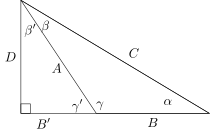
will need to first add a line that can split this into two right triangles with a shared
side. We accomplish this as follows:
Once we have this extra bit of information, we can see a couple of things.
The angle has the same measurement as the sum of angles and and the
line segment we called previously has the same length as the sum of and
.
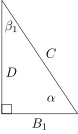
We can now throw away most of picture and just keep the triangle with sides , , and .
Since we already know that and we are left with finding all the sides of the following
triangle:
We can now find:
1.1 :
Now that we have those components we return to our larger picture and see that if
we remove and we instead have the triangle:
Since we already know that and we just found that we can proceed to
find:
1.1.1 : Now that we have those three pieces we can return to our original
picture to find that we have almost everything. While we have found what needs to
be we have not yet found or . However, since and we can find the last two
components of our original triangle as:
2 : Now we will find all of the missing angles and side lengths using the same , ,
and as before, but assume that is obtuse.
We previously added a line to split our triangle into two different right triangles,
however if we were tr try the same thing we would have to split the angle . We could
proceed that way, but instead we are going to take our triangle and make it bigger.
We do this by extending the side call until we can place our new side as
follows:
As before, we have a right triangle in this picture that we know enough information
about to find all of the pieces the triangle whose sides are , and . We now
throw away everything in the picture that isn’t a part of that triangle to
get:
As before, since we know and , we can use right triangle tools to find:
2.1 :
Since we now have and , we can now look back to our main picture and delete the
line segment and the line segment to get:
We use this to find:
2.1.1 :
With all of those pieces found we return to our original picture to find that is just
the difference of two of the angles we found and is just a difference of line segments.
Similarly, we found , but what we need is . This is less problematic than it might
seem, though, since is a straight line and so they are supplements. We can now state
our remaining missing pieces as: